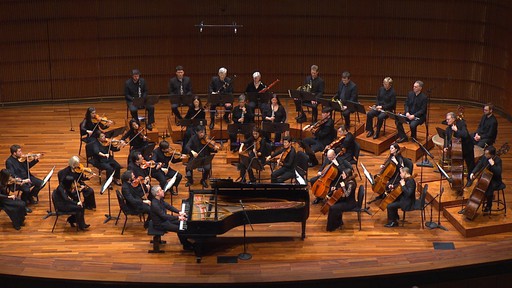
Most musical growth happens slowly and privately. A concerto festival is one of the few environments where significant things happen in a single week — and the effects tend to stay with you long after you leave.
Many pianists spend years in a fairly predictable cycle: private lessons, solo practice, the occasional recital or competition. It is a solid structure, and it produces real progress. But there is a kind of experience it rarely provides — performing a full concerto with a live orchestra, in front of an audience, after a week of intensive preparation with a professional faculty. That is a different category of musical event, and it tends to leave a mark.
A concerto festival is built around making that experience accessible. Here is what participants actually take away from a week like that.
Hearing the concerto as it was written
Most pianists preparing a concerto work from a two-piano reduction for months, sometimes years. It is a practical necessity, but it is also a limitation — a reduction is an approximation, and a fairly thin one. The first time you sit at the piano with a full orchestra playing around you, passages you have always thought of as solos turn out to be dialogues. Orchestral textures you knew from the score become something you feel physically, not just hear intellectually.
This shift in understanding tends to be permanent. Pianists who have performed with a real orchestra describe hearing their concerto differently afterwards — more completely, with a clearer sense of how the piano part fits into the whole. That changes how they practise it, how they teach it, and how they listen to recordings of it.
Masterclasses under real conditions
Masterclasses are a standard part of musical education, and most serious pianists have attended plenty of them. What makes festival masterclasses different is their proximity to an actual performance. When a faculty member works with you on a specific ensemble entry or a question of orchestral balance the day before your rehearsal, the feedback is immediately testable. You try it with the orchestra the next morning and find out whether it worked. That feedback loop — instruction, application, result — is much tighter than in a normal lesson setting, and it accelerates learning noticeably.
There is also real value in watching sessions that have nothing to do with your own concerto. A professor working through the Grieg with another pianist will address questions of timing, dynamics, and ensemble coordination that apply just as directly to the Rachmaninoff or the Beethoven you are preparing. By the end of the week, the accumulated effect of sitting in on many sessions — across different repertoire and different faculty members — adds up to a significant amount of musical learning.
A recording you can actually use
At the Piano Concerto Festival, every participant receives a professionally produced video recording of their concerto performance with the orchestra. For many pianists, this ends up being the most practically useful thing they take home. A recording of a full concerto performance — with a real orchestra, under real performance conditions — carries considerably more weight in applications and auditions than a studio recording of solo repertoire. It shows musical collaboration, ensemble experience, and the ability to perform under pressure, which are things that matter to conservatoires, competitions, and concert promoters alike.
The people you meet
Classical music is a fairly small professional world, and the connections formed during an intensive week at a festival tend to last. The pianists you share rehearsals, meals, and masterclass observations with in July often reappear later — as colleagues, collaborators, or simply as people who understand what you went through that week. International programmes in particular bring together musicians from very different training backgrounds, and those cross-cultural professional relationships can be genuinely useful throughout a career.
This is not something that is easy to plan for or manufacture. It tends to happen naturally when serious musicians spend a concentrated week working toward a shared goal in an unfamiliar city. The community that forms is a byproduct of the work — but it is a byproduct worth mentioning.
Who should consider applying
The Piano Concerto Festival is open to pianists of all levels and backgrounds, which in practice means the common thread among participants is not career stage but seriousness of preparation. Some arrive as conservatoire students. Others are working professionals adding a concerto to their repertoire. Some are returning to serious playing after a gap. What they share is a concerto they have worked on carefully and a genuine interest in performing it with a real orchestra.
If you have been working toward a concerto and have not yet had the opportunity to perform it with a full ensemble, the festival is a straightforward way to bridge that gap. The 6th edition takes place in Paris from 12 to 19 July 2026, and applications are open now.
